SPECIAL EDITION 

Alignment before investment in healthcare projects

A reminder of the importance of individuals and interactions over processes  

AGILE IS A GUIDING PROCESS

The term “agile” has been borrowed so widely that its meaning has come to be associated with speed, with associated jargon that includes sprints, stand-ups, and scheduling techniques. It is worth remembering that the original approach to being agile in project management was centred on behaviour.
We really wanted to prioritize individuals and interactions over processes and tools, working results over exhaustive documentation, collaboration with the client over the negotiation of a contract, and responding to change over following a plan.


Why it fits healthcare — and where it doesn’t

You can’t build a hospital the same way you build software. Once the concrete is poured and the units are occupied, change becomes exorbitantly expensive. The further down the schedule you are, the more a second thought costs. If we adopt a conventional approach to agile processes where we build now and patch or revise later, then an agile mindset has no business anywhere near construction. Still, there are aspects to agile thinking worth considering.

Healthcare projects are fundamental exercises in managing uncertainty. A complex healthcare project is at its least certain during the earliest stages when consensus on what is actually being built has not yet been achieved.

It is here that clinical workflows, competing departmental priorities, budget, and the daily experience of staff and patients are still a set of loosely held assumptions. It is during this stage that iteration is cheap, a conversation can be revisited, and a diagram can be redrawn. This is the time when programmatic assumptions can be tested and discarded at almost no cost. Clearly, the agile mindset belongs in predesign, where ideas are malleable, and definitely not during construction when changes are expensive.  

How Clover adapts agile thinking

During a recent user group meeting to solidify the programmatic requirements of a hospital, a key stakeholder raised a concern that fell outside the agenda. To respect the other attendees’ time, we deferred the issue, flagging the question with our project executive team and then arranging a separate session dedicated to that stakeholder’s issue.


That investment in validating everyone’s input was worthwhile. The experience was very telling. While the issue raised was legitimate, it had previously gone unaddressed because the process was not designed to include it. 

This scenario illustrates a core principle of how Clover works. A well-planned process will not capture everything the people who use a building need to tell you.  

When planning our agenda, we had not included specific categories of inputs that mattered to the stakeholder.

As a result, we brought the internal team together through a collaboratively-based two-hour workshop to reach a consensus for concrete resolutions and next steps.


When a single stakeholder believes in something, that conviction is worth listening to because they have identified a gap in a process built to ask what users actually need. Avoiding that gap is where projects can fail. End users may not speak the technical language that support complex healthcare projects, but their buy-in on designing for the daily use of a building is essential. Listening to their concerns and giving space to decide whether a change to the project design is essential to achieve a successful outcome.

Creating something concrete for the client to react to, challenge, and refine before any commitment is locked in by establishing a shared “definition of done” the rest of the project is measured against.

The Clover Approach draws from an agile methodology as a mindset rather than a procedure. Where it serves our projects, we adapt a linear, waterfall sequence into something more responsive. We follow a hybrid approach that follows a defined structure but leaves room to adapt. Developing a Predesign Report is the central outcome to our work, and the first point at which a project’s range of priorities are brought into a single, documented, testable alignment. Creating something concrete for the client to react to, challenge, and refine before any commitment is locked in by establishing a shared “definition of done” the rest of the project is measured against.

adapts agile thinking


Predesign as the overlap
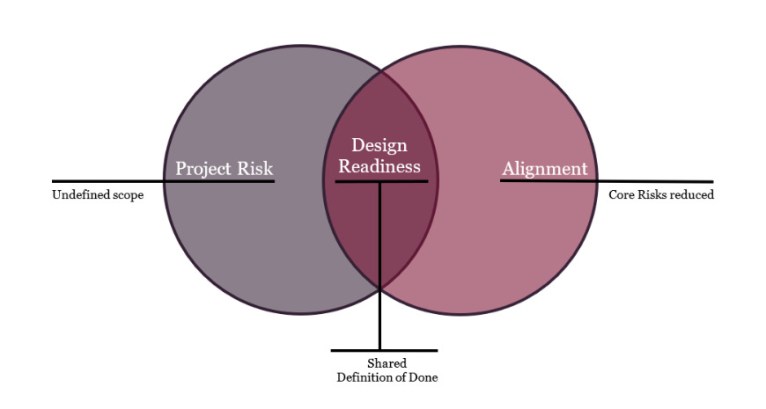


Step back from the single meeting, and a larger picture appears. Every project of this scale begins in contention, but certainly not in conflict! We begin with a room of legitimate, competing claims about what the building should be. Our goal is to seek out a path to convergence with a single, documented, defensible account that everyone has agreed to accept. Most of a project’s risk lives in the distance between those two states. Much of those risks become reality when a team fails to close that distance.    

We can use a diagram that references the idea of the “minimum against the viable” in what is known as the Minimum Viable Product. Visualizing contention against convergence, our Predesign Report exists within the overlap, a place where competing priorities have been fully heard and resolved into something the client can hold, challenge, and sign-off. It is not the maximal version of every stakeholder’s wish, nor a thin compromise satisfying nobody. It is the area where we achieve an agreement strong enough to build on.


Alignment is simply risk reduction by another name.

As Clover, we listen to the individual when the individual is telling us something the process overlooked. We create tangible outputs early, so that people react to a real building rather than to their own imagined preconceptions. At this stage, we deliberately allow room to change our minds, when such changes remain inexpensive. Alignment is simply risk reduction by another name.

Converting contention into convergence before the design is locked in yields a defensible predesign decision that inevitably benefits the entire project over the long-term.


THE CLOVER APPROACH